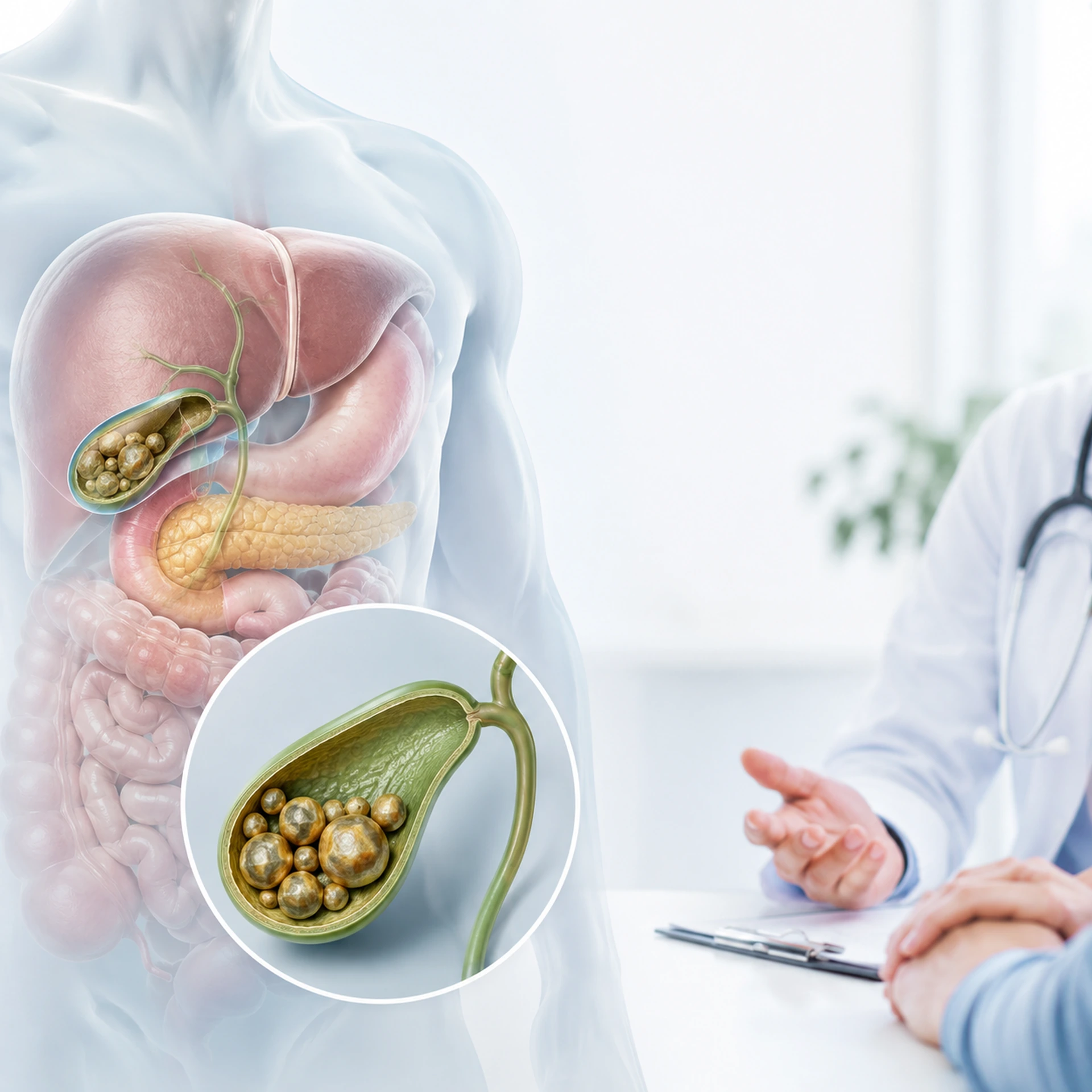
Short answer: Gallstones can remain in the gallbladder for years without causing symptoms. When a stone blocks the outlet of the gallbladder or the bile ducts, pain in the upper right or upper middle abdomen, nausea, and vomiting may occur. Severe pain that lasts, fever, chills, or jaundice can suggest a complication and requires prompt medical assessment.
Gallstones are common, but simply knowing that “there is a stone in my gallbladder” does not determine the treatment plan. What matters is whether the stones cause symptoms, interfere with bile flow, or lead to complications.
What does the gallbladder do?
The gallbladder is a small organ beneath the liver. It stores bile that is continuously produced by the liver and releases it into the small intestine, particularly after meals. Bile helps digest fats and helps the body eliminate certain substances through the intestine.
When the balance of cholesterol, bilirubin, and other components of bile changes, crystals may form. These crystals can gradually grow into gallstones.
Why do gallstones form?
There is no single cause. The chemical composition of bile, the way the gallbladder empties, and individual risk factors all play a role.
Factors associated with higher risk can include:
- Increasing age,
- Female sex,
- Overweight or obesity,
- Very rapid weight loss,
- Pregnancy,
- Some metabolic conditions,
- A family history of gallstones,
- Certain intestinal and liver diseases.
Having a risk factor does not mean that a person will definitely develop gallstones.
Do gallstones always cause symptoms?
No. Stones that remain in the gallbladder without blocking a duct can cause no symptoms for a long time. These are often called silent gallstones and may be discovered incidentally on an ultrasound performed for another reason.
Management differs between silent stones and stones that repeatedly cause pain or complications. There is no rule that everyone with a gallstone automatically needs surgery.
Where is gallstone pain felt?
Pain related to gallstones is most commonly felt:
- In the upper right abdomen,
- In the upper middle abdomen,
- Sometimes radiating to the back or the right shoulder blade and shoulder area.
The pain is often steady and significant. It can occur after a heavy or high-fat meal. If a stone blocks the outlet as the gallbladder contracts after eating, a pain attack can develop.
Diseases of the stomach, pancreas, liver, heart, and intestine can also cause upper abdominal pain. Location alone cannot confirm that gallstones are the cause.
How long does a gallstone attack last?
Typical biliary colic usually begins suddenly, remains fairly constant for a period of time, and improves when the obstruction resolves. Very brief stabbing pains lasting only minutes or pain that remains completely unchanged for days may not fit the classic pattern.
Pain that continues for several hours, becomes progressively worse, or is accompanied by fever requires assessment for complications such as inflammation of the gallbladder.
What is gallbladder inflammation?
When a stone blocks the gallbladder outlet for a prolonged period, inflammation of the gallbladder wall can develop. This is called acute cholecystitis.
With cholecystitis:
- Upper right abdominal pain lasts longer,
- The area can become very tender,
- Fever, nausea, and vomiting may occur,
- General condition may deteriorate.
This is different from an uncomplicated short-lived pain attack and needs medical assessment.
Why is jaundice important?
A stone leaving the gallbladder can enter the common bile duct and block the flow of bile. When bile products build up in the bloodstream, symptoms may include:
- Yellowing of the eyes and skin,
- Dark urine,
- Pale stools,
- Itching.
Infection above a blocked bile duct can cause cholangitis, a potentially serious condition. Fever, chills, abdominal pain, and jaundice occurring together require urgent assessment.
Can gallstones cause pancreatitis?
Yes. Because the bile duct and pancreatic duct are anatomically close, a small gallstone can obstruct pancreatic drainage and trigger acute pancreatitis.
Severe, persistent upper abdominal pain that radiates to the back, particularly with significant nausea and vomiting, needs assessment for pancreatitis and other urgent conditions.
How are gallstones diagnosed?
Assessment begins with medical history and physical examination. Depending on the clinical situation, tests may include:
- Abdominal ultrasound,
- Complete blood count,
- Liver and bile-duct blood tests,
- Pancreatic enzyme tests,
- MRCP, endoscopic ultrasound, or CT when needed.
Ultrasound is a commonly used, accessible, radiation-free test for gallbladder stones.
How is gallstone treatment planned?
Treatment depends on symptoms and the risk or presence of complications.
Gallstones without symptoms
Many people do not need specific treatment and can be followed clinically. The approach can be different in certain special high-risk situations.
Gallstones that cause symptoms
When people have repeated biliary colic or complications, removal of the gallbladder may be considered. The most commonly used method is laparoscopic cholecystectomy.
Surgery usually removes the entire gallbladder rather than only taking out the stones. Removing stones alone would not prevent new stones from forming in the same gallbladder.
Where does bile go after the gallbladder is removed?
The liver, not the gallbladder, produces bile. After the gallbladder is removed, the liver continues to make bile and it flows directly through the bile ducts into the small intestine.
Most people can return to a normal diet after surgery. Some may have temporary digestive symptoms with high-fat foods early in recovery, and individual advice is provided by the surgical team.
Can diet dissolve gallstones?
There is no reliable diet that dissolves existing gallstones. Dietary choices can influence symptoms in some people and support general metabolic health.
Very rapid weight loss is known to increase the risk of gallstones, so weight-loss plans should be balanced and sustainable.
When should you see a general surgeon?
Repeated upper-right abdominal pain, particularly typical attacks after meals, or a known gallstone on previous ultrasound are reasons to consider a general surgical assessment.
Seek faster medical assessment when there is:
- Severe and persistent abdominal pain,
- Fever or chills,
- Jaundice,
- Repeated vomiting,
- Marked deterioration in general condition.
Conclusion
Gallstones may remain silent for many years. Problems arise when a stone obstructs bile flow and causes recurring pain or complications. Repeated upper-right abdominal pain should not simply be dismissed as “gas,” and fever or jaundice should prompt faster medical evaluation.
Frequently asked questions
Does everyone with gallstones need surgery?
No. The approach to stones that do not cause symptoms can be different. Surgery is decided according to symptoms and complication risk.
Can gallstones feel like stomach pain?
Yes. Gallstone pain is felt in the upper abdomen and can be described as “stomach pain.” Examination and imaging help identify the true source.
Can a gallstone pass on its own?
Small stones can pass into the bile duct, but this is not necessarily good news. They can cause duct obstruction, jaundice, or pancreatitis.
Can gallstones be seen on ultrasound?
Ultrasound is one of the first tests used to assess gallbladder stones.
Can stones return after gallbladder surgery?
Once the gallbladder is removed, stones cannot reform inside it. Stones can rarely occur or remain in the bile ducts.
Can fatty food trigger pain?
Because the gallbladder contracts after meals, fatty or heavy meals can trigger symptoms in some people.