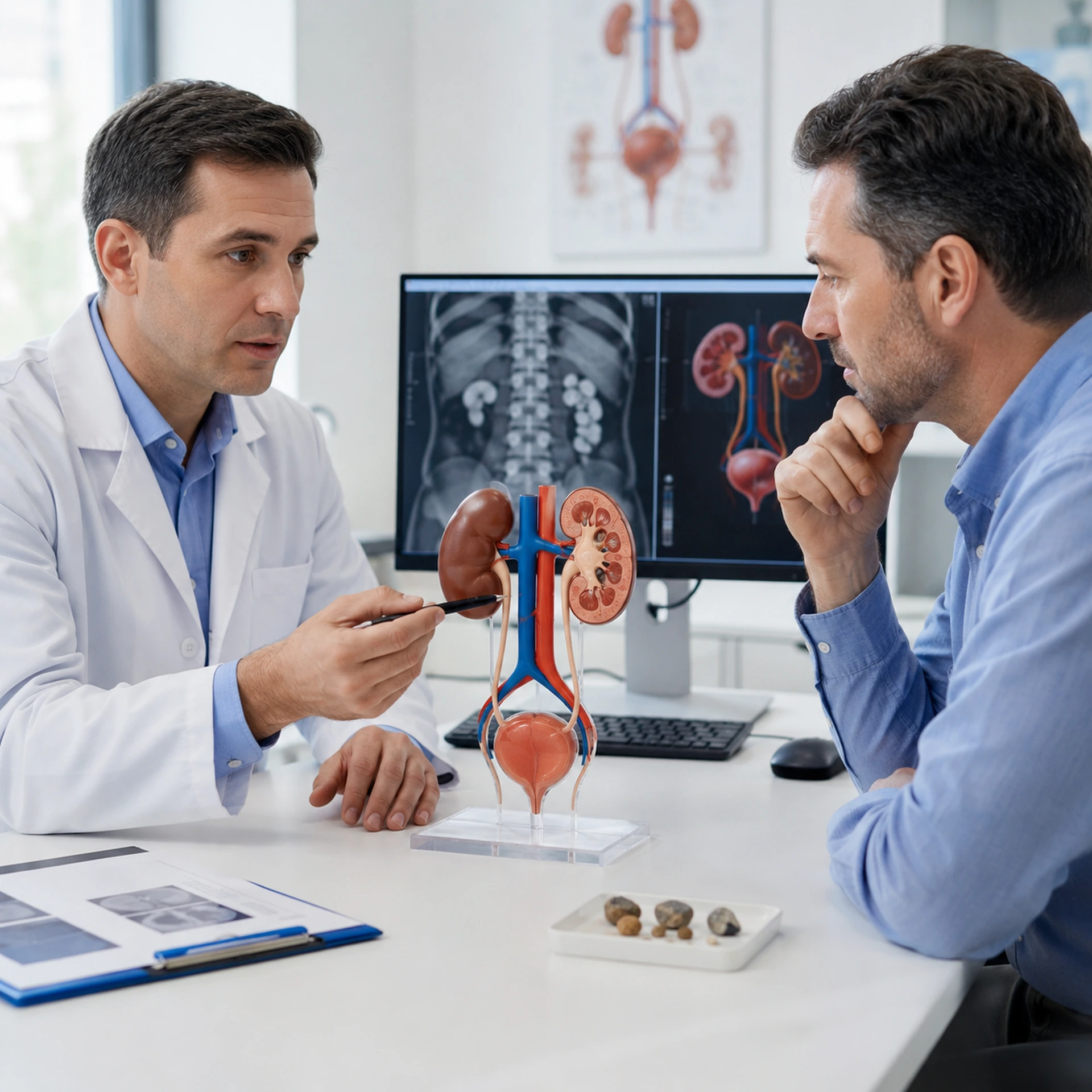
Short answer: A kidney stone can remain silent while it stays inside the kidney. When it moves into the ureter, it may cause sudden pain in the side or back that comes in waves and can radiate toward the groin. Nausea, vomiting, blood in the urine, and frequent urination may occur. Fever and chills with suspected stone pain require urgent assessment because infection may be present behind an obstruction.
Kidney stone pain can be extremely severe, but not every stone causes pain and not every episode of back pain is a kidney stone. The stone's location and size, whether it obstructs urine flow, and whether infection is present all influence treatment.
What is a kidney stone?
Minerals and certain organic substances that are normally dissolved in urine can crystallize under certain conditions. Crystals may grow and join together, forming stones in the kidney or urinary tract.
There are several types of stones. Calcium oxalate and other calcium-containing stones are most common, while uric acid, struvite, and cystine stones also occur. Knowing the stone composition is particularly useful when stones recur because prevention can then be more individualized.
Why do kidney stones form?
There is no single cause. Concentrated urine, higher levels of stone-forming substances, or reduced levels of natural stone inhibitors can all play a role.
Risk factors include:
- Inadequate fluid intake,
- A previous kidney stone,
- Family history of stone disease,
- High salt intake,
- Certain dietary patterns,
- Obesity and metabolic conditions,
- Some bowel diseases or operations,
- Parathyroid disorders,
- Certain medicines.
In hot climates, heavy sweating combined with insufficient fluid intake can make the urine more concentrated and increase stone risk.
Where is kidney stone pain felt?
A stone that remains still inside the kidney may cause no pain. When it enters the ureter, the tube between the kidney and bladder, it can interfere with urine flow and trigger strong contractions of the ureter.
Pain commonly begins:
- In the flank or side of the back,
- Just below the ribs,
- Along the side of the abdomen.
As the stone moves downward, pain may radiate toward the lower abdomen, groin, or genital area.
This pattern is known as renal colic. Pain often rises and falls in waves. Unlike many other causes of abdominal pain, people with renal colic may struggle to find a comfortable position and may feel the need to move constantly.
Can kidney stones cause blood in the urine?
Yes. A stone can irritate the lining of the urinary tract and cause microscopic or visible bleeding. The urine may appear pink, red, or brown.
Blood in the urine is not specific to stones. Urinary infections, prostate disease, kidney disease, and urinary-tract cancers are among many other causes. Painless blood in the urine in particular should always be evaluated.
Why do nausea and vomiting occur?
The nerve pathways of the kidney and digestive tract are closely linked, so severe renal colic can trigger nausea and vomiting. The intensity of pain itself can also contribute.
Medical assessment is appropriate when vomiting prevents fluid or medicine intake, when pain cannot be controlled, or when the person becomes markedly weak or unwell.
Why is stone pain with fever an emergency?
A stone that blocks urinary drainage can allow infection to develop in a poorly drained kidney. Infection behind an obstruction can progress rapidly and may cause sepsis.
Urgent urologic assessment is needed when stone symptoms occur with:
- Fever,
- Chills,
- Marked weakness,
- Nausea and vomiting,
- Deterioration in general condition.
Antibiotics alone may not be enough in this situation. The kidney may need urgent drainage with a ureteral stent or nephrostomy.
How are kidney stones diagnosed?
Assessment may include medical history and physical examination together with:
- Urinalysis,
- Urine culture,
- Kidney-function blood tests,
- Complete blood count.
Imaging may include ultrasound or low-dose non-contrast CT. Pregnancy, childhood, previous stone history, and the clinical situation influence which imaging method is most appropriate.
Do all kidney stones pass naturally?
No. The chance of spontaneous passage depends mainly on stone size and where it is located in the ureter. Smaller stones and stones close to the bladder are more likely to pass. Larger stones or stones causing prolonged obstruction may require intervention.
The idea that “the more water I drink, the faster the stone will pass” is not correct in every situation. During severe obstruction and renal colic, forcing excessive fluid can worsen pain. Fluid intake should be sensible and individualized.
How are kidney stones treated?
Observation and pain control
Small, uncomplicated stones with a good chance of passing can sometimes be managed with pain relief and close follow-up. For selected ureteral stones, the urologist may consider medication that can facilitate passage.
ESWL
Extracorporeal shock wave lithotripsy uses shock waves from outside the body to break a stone into smaller fragments. Stone location, size, and hardness affect success.
Ureteroscopy
A thin endoscope is passed through the urinary tract to reach a stone in the ureter or kidney. The stone can be fragmented with a laser and pieces removed. A temporary ureteral stent may be placed afterward.
Percutaneous nephrolithotomy
For large or complex kidney stones, a small tract is created through the back into the kidney so that the stone can be removed.
Treatment choice depends on more than size alone. Stone location and hardness, kidney anatomy, and the patient's overall health are also considered.
Do kidney stones come back?
Yes. A person who has formed one stone has an increased risk of future stones. Particularly with recurrent stone disease, treating the current stone is only part of the job; the reason for stone formation should be investigated.
Whenever possible, a passed or surgically removed stone can be analyzed. In selected patients, a 24-hour urine collection can assess calcium, oxalate, uric acid, citrate, urine volume, and other risk factors.
How can the risk of new stones be reduced?
For many stone formers, the basic goal is to produce an adequate volume of dilute urine. Fluid requirements vary with climate, physical activity, and health conditions.
General measures include:
- Drinking enough water throughout the day,
- Reducing excessive salt intake,
- Keeping animal-protein intake balanced,
- Maintaining a healthy weight,
- Not unnecessarily eliminating normal dietary calcium,
- Following a diet tailored to the specific stone type when needed.
People who need fluid restriction because of heart or kidney disease should set their fluid goal with their doctor.
“Should I stop calcium?”
People with calcium stones should not automatically eliminate milk and other dietary calcium sources. Too little dietary calcium can increase intestinal absorption of oxalate and, in some people, raise the risk of calcium oxalate stones.
Dietary calcium and calcium supplements are not evaluated in exactly the same way. Individual recommendations should be based on stone analysis and metabolic assessment.
Conclusion
In kidney stone disease, relieving pain is only one part of treatment. It is also essential to determine whether the urinary tract is obstructed and whether infection is present. Stone pain with fever can be an emergency. After treatment, analyzing the stone type and individual risk factors can help reduce the chance of recurrence.
Frequently asked questions
How long does it take for a kidney stone to pass?
Depending on size and location, passage may take from a few days to several weeks. Follow-up is important to make sure obstruction is not persisting.
Which side hurts with a kidney stone?
Pain is usually on the side of the affected kidney or ureter, although it can radiate into the abdomen and groin.
Does lemon juice dissolve kidney stones?
Citrate can be helpful in the prevention of some stone types, but lemon juice is not a treatment that dissolves all existing stones.
Can it burn when a stone is passing?
As a stone approaches the bladder, urinary frequency and burning can occur. Infection can cause similar symptoms and should be considered when appropriate.
Does kidney stone surgery mean open surgery?
Most stones today are treated with endoscopic or minimally invasive methods. Open surgery is rarely required.
Can kidney stones damage the kidney?
Prolonged obstruction or infection can affect kidney function. Waiting indefinitely for a stone to pass without appropriate follow-up is therefore unsafe.